.png)
Text AI vs Image AI: Who Creates Better Content?
Updated: Nov 11, 2025
Explore how Text AI and Image AI differ in creativity, application, and collaboration potential.
From blog posts written by machines to visuals generated in seconds, AI has revolutionized how we create. Yet, one question remains - when it comes to producing creative, high-quality content, who does it better? In this article, we compare Text AI and Image AI to see how each performs in creativity, usefulness, real-world applications, and how combining both might just unlock the future of content creation.
When AI Speaks vs When AI Paints
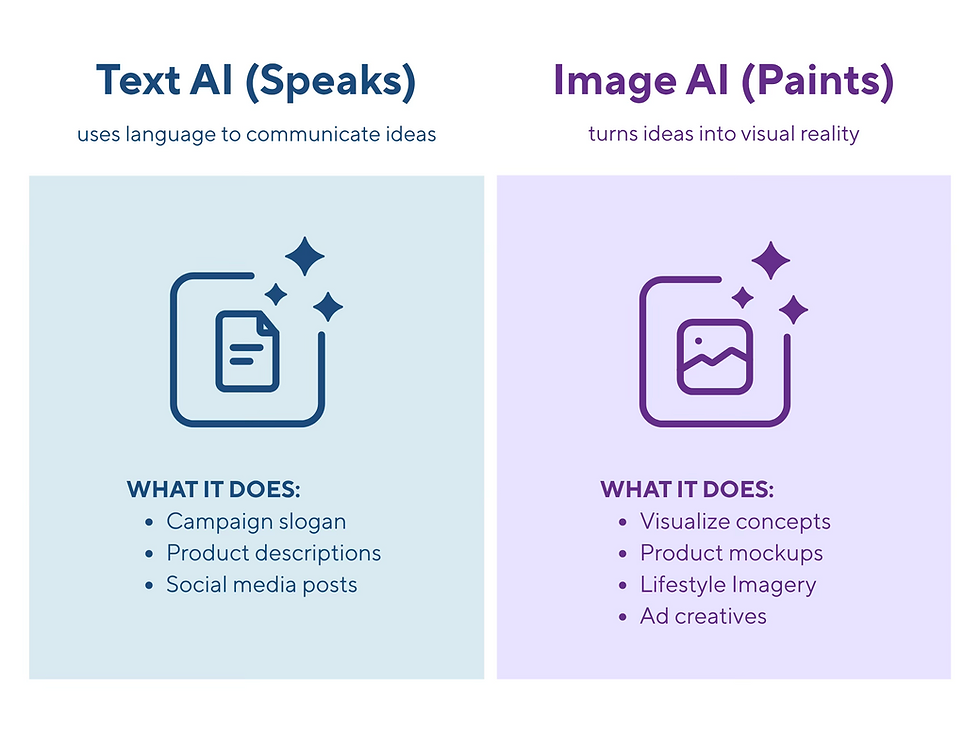
Artificial Intelligence has moved from science fiction to daily reality. It writes our emails, designs our ads, and even generates brand-new images from a few lines of text. But behind all this innovation lies a fascinating divide: while Text AI uses language to communicate ideas, Image AI turns those ideas into visual reality.
Imagine you’re launching a new product. Text AI can write the campaign slogan, product descriptions, and social media posts. Meanwhile, Image AI can visualize your concept - showing how the product looks, feels, or fits into a customer’s lifestyle.
Both are powerful, but in completely different ways. To understand who creates “better” content, we need to see how each one works, their strengths, and how they complement each other in the creative process.
Understanding the Two Worlds of AI Creation
What is Text AI?
Text-based AI refers to tools trained to understand and generate human-like text. These systems can write articles, scripts, emails, and even code. They use large language models (LLMs) to predict and craft coherent responses.
Examples:
ChatGPT (OpenAI)
Gemini (Google)
Claude (Anthropic)
Common Use Cases:
Blog writing and SEO content
Social media captions
Email campaigns
Chatbots and customer support
What is Image AI?
Image-generation AI focuses on creating or editing visuals based on text prompts. These systems are trained on millions of images to learn patterns, colors, lighting, and composition.
Examples:
DALL·E (OpenAI)
Midjourney
Stable Diffusion
Common Use Cases:
Marketing banners and concept art
Product visualization
Branding and creative design
Visual storytelling
Creativity Showdown: Text AI vs Image AI
Criteria | Text AI | Image AI |
Core Output | Words, ideas, tone, structure | Visuals, color, layout |
Strengths | Logical flow, persuasion, storytelling | Aesthetic, imagination, emotional impact |
Limitations | May sound generic if overused | May produce unrealistic or distorted visuals |
Best For | Articles, scripts, content strategy | Design, branding, campaigns |
Human Input Needed | Editing and fact-checking | Style direction and visual refinement |
Key takeaway:
Text AI is great for strategic communication: it persuades, informs, and educates.
Image AI wins in visual inspiration: it attracts, impresses, and communicates emotion instantly.
Real-World Applications: Where Each AI Shines
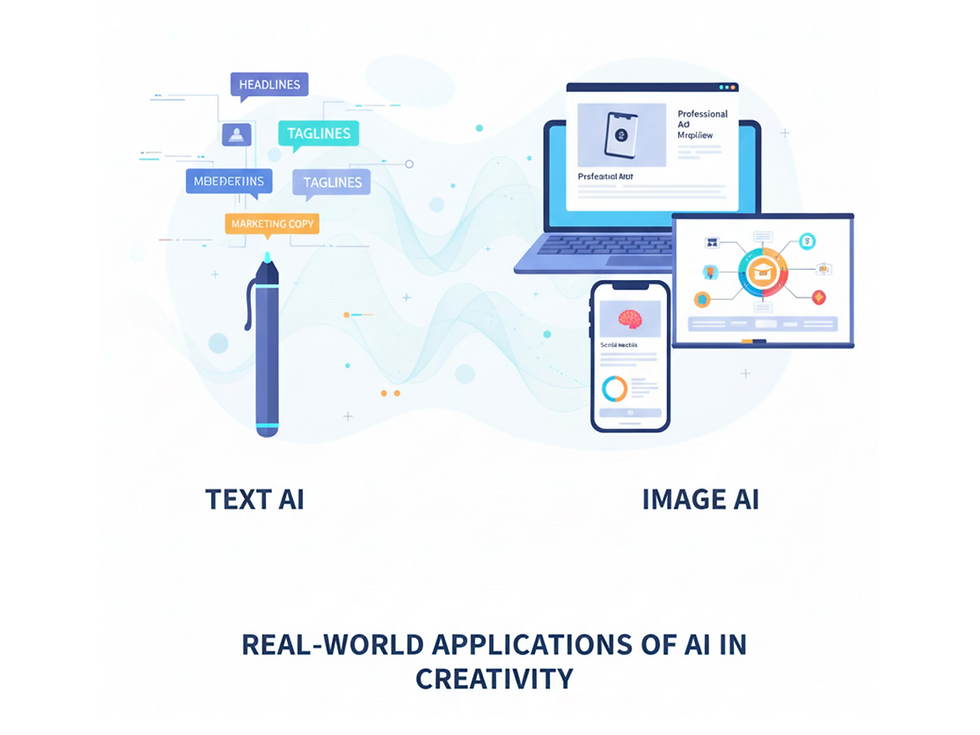
The line between writing and design has blurred, and AI is leading that convergence. Let’s look at how Text AI and Image AI perform in real creative scenarios.
Marketing and Advertising
For modern marketers, Text AI serves as the strategist. It crafts brand messaging, writes ad copy, and ensures consistency across platforms. It can even analyze tone and suggest improvements based on audience data. Meanwhile, Image AI becomes the designer, visualizing campaign ideas or generating product mockups within seconds.
A brand launching a new skincare line, for example, could use Text AI to write its tagline - “Glow with every sunrise”, and Image AI to create a soft, radiant campaign image that matches the mood. The result is cohesive communication with minimal manual effort.
Social Media Content
Social platforms demand fast, visually appealing content. Text AI helps brands write catchy hooks, relatable captions, and informative threads. Image AI then generates fresh visuals that fit the style, from playful illustrations to sleek photography. The combination allows creators to produce more content, faster, without compromising quality.
Education and Training
Text AI is transforming education by generating summaries, lesson plans, and quizzes in seconds. But learning isn’t only about words; visuals matter too. That’s where Image AI steps in - producing infographics, concept diagrams, and illustrations that make complex information easy to grasp. When both work together, education becomes more engaging and accessible for everyone.
The Future of Creation: Collaboration, Not Competition
While it’s tempting to compare them, Text AI and Image AI aren’t rivals - they’re partners. The future of content creation lies in how effectively they collaborate.
Think of a workflow where Text AI first outlines a blog article or marketing idea. Then Image AI translates that idea into visuals that match the tone and mood. The result is a unified creative process that merges storytelling with visual emotion.
This collaboration not only speeds up production but also democratizes creativity. A small business owner can now write a campaign, design visuals, and publish content in a single afternoon, tasks that once required entire teams. AI doesn’t replace human creativity; it amplifies it, giving more people the tools to express their ideas.
FAQs: Common Questions
1. Which AI is more creative: text or image?
They’re creative in different ways. Text AI is better at logical storytelling and persuasive writing, while Image AI captures mood and emotion through visuals. The most impactful content comes when you combine both.
2. Can Image AI generate good copy for ads or posts?
Not yet. It can include text in images, but it doesn’t understand grammar or meaning deeply. Text AI is still the better choice for writing and communication.
3. Will AI tools replace writers and designers?
AI won’t replace humans - it assists them. It automates repetitive work so creators can focus on strategy, originality, and emotion - the things machines can’t fully imitate.
4. Can businesses use both together?
Yes, and they should. Using Text AI for messaging and Image AI for design gives brands a balanced, efficient workflow that saves time and boosts creative consistency.
Conclusion: The Best Creator Is the Collaboration
So, who creates better content - Text AI or Image AI? The real answer is neither can win alone.
Text AI offers the structure, reasoning, and message that give ideas their shape. Image AI adds the emotion, color, and imagination that make those ideas unforgettable.
When used together, they transform not only how we create, but also who gets to create. From businesses to individual creators, AI collaboration opens a new era of content that’s faster, smarter, and beautifully human at its core.
Want to elevate your creative process? Explore our guide on AI Content Tools and discover how to integrate both Text and Image AI into your workflow.


Comments